
AI-Assisted Instruction and Higher Ed’s ROI Dilemma
Proving faculty's educational value in the Age of AI!


Image TungArt7 via Pixabay
An Academic AI Paradox
AI-assisted instruction creates two significant dilemmas potentially undermining Higher Education’s return on investment (ROI). First, if instructors use Artificial Intelligence (AI) to offload significant, time-consuming tasks, how are they reinvesting their freed-up time to enhance the learning experience? Second, if faculty rely on AI to complete tasks that students themselves can accomplish with the same tools, what added value justifies the rising cost of tuition?
In this context, what unique value do human instructors bring to the learning process? And, more importantly, how do faculty and institutions communicate that value?
Consider the case of coursework evaluation. It’s already a widespread practice for faculty to use AI to grade anonymized student submissions. But students can do that for themselves using any mainstream AI chatbot and a rubric (sharing rubrics with students is a best teaching practice) - so where’s the benefit? This raises a difficult question: what unique instructional value does AI-assisted grading provide beyond efficiency?
Instructional Complexity
Regardless of whether their courses are online or in-person, faculty simultaneously act as:
Content Designers/Curators – Developing, organizing, and updating course materials, readings, and resources
Content Experts – Connecting theory to practice through content knowledge expertise
Facilitators/Presenters – Guiding discussions, fostering critical thinking, and cultivating a welcoming learning environment
Evaluators/Assessors – Designing assessments, providing feedback, and measuring student achievement
Coaches/Mentors – Supporting students’ academic, professional, and personal development through guidance and encouragement
AI disrupts teaching in the sense it currently excels at content design/curation and evaluation/assessment: it generates instructional resources at scale, applies rubrics, and drafts assessment feedback.
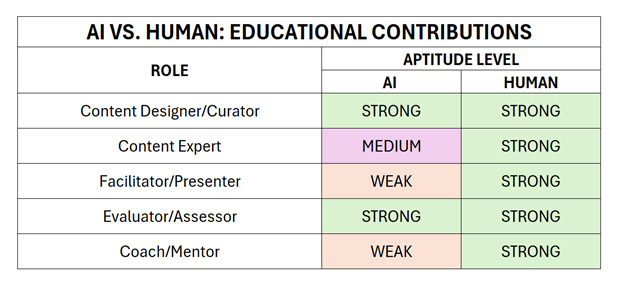
However, the technology struggles with context, subtlety, and the nuanced social understanding humans provide; humans still outperform even the most advanced models at facilitating more meaningful discussions, mentoring students, and possessing in-depth (accurate) content knowledge (ChatGPT-5, when connected to the Internet, hallucinates 9.6% of the time; of additional interest is, “AI Chatbots Are Feeding You More False Information Than Ever.”)
Being Proactive in a Changing Academic Environment
AI-assisted instruction, therefore, creates two significant and related challenges:
How can faculty demonstrate that the human contributions exceed those of AI in the classroom?
How can instructors leverage the time saved through AI to create richer, more meaningful educational experiences?
Without clear strategies, Higher Education risks further reducing its perceived value at a time of increasingly intense public skepticism, criticism, and scrutiny.
Meeting Challenge #1: Highlighting Human Uniqueness
If students can use AI to generate feedback and learning activities, they may wonder: why do I need a human instructor at all?
Faculty should proactively showcase their irreplaceable contributions by making the human element of teaching transparent and top-of-mind from Day 1!
Badge It
Highlight premier activities, assessments, and resources you are most proud of that are not created by AI. A fun “Made by a Human” badge reminds students of the intentionality, passion, and creativity of their human instructorsPlace badge in the syllabus or in assignments
Ask students to earn similar badges for their independent, AI-free work!

Image by Gemini Imagen3 (if you like it - copy and paste it!)
Getting to Know Me
Share the challenges, setbacks, ah-ha! moments, and victories of your educational journey. Tell stories reflecting the persistence, resilience, and hard work that shape your philosophy, expectations, and approaches to teaching and learningPull Back the Curtain
Reveal the behind-the-scenes work that goes into creating a lecture, discussion bard, or assessment. Let student see the dynamics of selecting source materials, deciding on lecture topics, creating assessments, or even establishing syllabi policies!Record short videos for posting in your LMS or sharing in class
Highlight AI Missteps
Showcase examples where AI gets concepts wrong or produces incorrect responses. Use these “teachable moments” to demonstrate the limitations of AI, and, more importantly, the necessity of human content knowledge expertise, critical thinking, agency, and judgmentDevelop assignments or group discussions around significant AI errors
Ask students to constructively critique AI-generated content
Hold discussions on the implications of misleading AI output
Human + AI Collaborations
Frame AI as a collaborative partner rather than a competitor. Design activities where students explore how AI can enhance, but not replace, human expertiseModel examples of successful/appropriate human + AI collaboration in which the human maintains agency and oversight
Meeting Challenge #2: Turning Time Savings Into Increased Quality
When faculty use AI to streamline repetitive tasks like grading or content generation, they must employ the time savings in ways that directly benefit students. Instructional responses could include:
Expand office hours
Offer additional opportunities for one-on-one or small-group conversations to build stronger relationships and provide personalized support
Provide personalized tutoring sessions
Host review sessions or skill-building workshops addressing common challenges such as note-taking, writing a thesis statement, or providing evidence
Foster community
Integrate more opportunities for groupwork or class-wide discussions
Integrate Universal Design for Learning (UDL)
Embed more approaches to engagement, representation, and action & expression as outlined by CAST
Why not advertise the expansion of more robust, and frequent, faculty-student interactions in the syllabus via an “Instructor Pledge”?
Instructor AI Pledge
With the goal of providing more engaging instruction and personalized support, I use institution-approved AI tools to assist with routine course development including:
Creating quiz and exam questions
Writing discussion prompts
Drafting announcements
Grading anonymized work against writing rubrics
Generating learning materials and other resources
Streamlining these tasks gives me more time to support students throughout the semester. (Please refer to the syllabus or Canvas Calendar for specific dates, times, and locations.)
Expanded Student Supports:
Two additional office hours per week, beyond the required five
Bi-weekly online support sessions focused on academic skills development (e.g., note-taking, outlining, brainstorming, time management, organization)
Monthly Q&A sessions in Room 32a, Student Center — open forum for content-related and course policy questions
With a new semester just having begun, now is the time to intentionally promote the distinct value of human-led instruction!